











You've been struggling with your attention, constantly fighting yourself rather than finding flow.

Your relationships are burdened by needing to keep you on track.

You find flow but don't know how you get there.

Your Inbox is constantly flooded.

You get into the flow of something and then lose track of other important commitments.

You fear taking on commitments because you can't keep promises to yourself.

You're open-minded about learning in an online community.








-

The Voyage, The Visit, and the Lean into Mastery
A wandering mind is a powerful and creative mind. We'll orient ourselves to these strengths and consider how we can begin building on them. We'll outline the ideas and exercises that you'll be learning and practicing along the way.
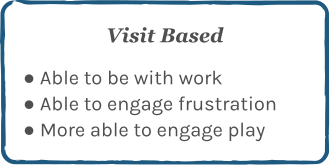
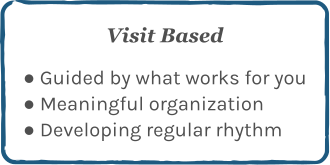
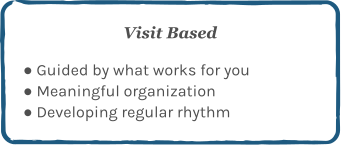
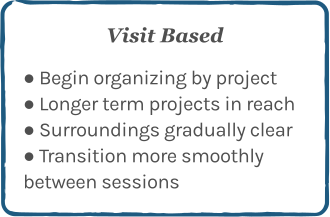
We will begin using the Visit method of engaging work in its simplistic form.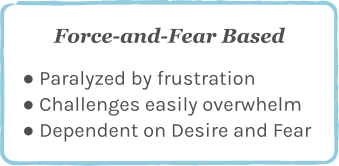
-
The Anchor & Wind Technique
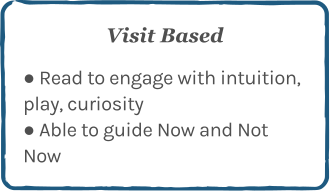
A wandering mind hardly likes being told what to do, whether that's from someone else or even yourself.
Writing lists means we have to do them, update them, or *aghh!!* just get rid of them because “I just know what I gotta do next!” and then forgetting one more thing…
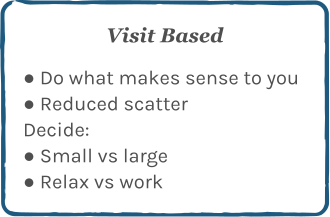
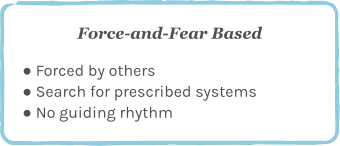
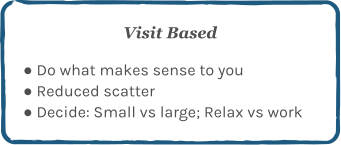
By using the Anchor & Wind Technique, you'll be able to make clearer decisions as to where you want your mind to be and redirect yourself when heading off track.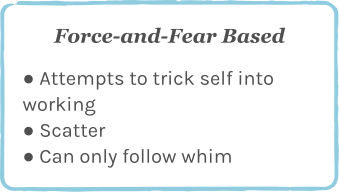
-

The Organizing Compass
Motivation, energy, whatever we want to call it, can be lacking. We might want to do something, but making it happen can be a struggle. The approach to organize is no exception.
We can use the strength of a rhythmic visits to begin engaging the frustrations of our environments.
We'll look at how we can guide natural forces to start deliberately impacting the world around ourselves.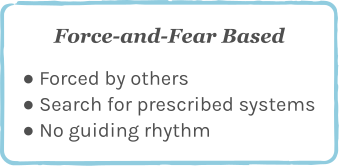
-

Winding Down – Maps, Lighthouses, & Distant Voyages
Reminders can be a great way to create a mess. The number of badges, the sounds they make, and more all create a sea of things, each trying to shout louder than the next one to get your attention. It can be quite easy to brush them off without even realizing you're doing so.
By applying the principles of the mind's momentum, you can start creating meaningful guides so that when they appear, you'll not only see them, but you might even welcome them.
Further, we'll begin creating Project Maps, effective save points that let us carry our work forward over longer courses.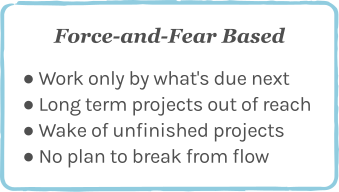
-

Getting Started - Raising Sails & Making Visits
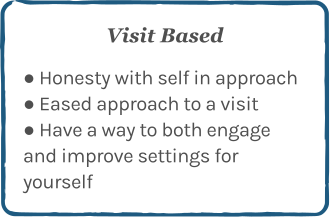
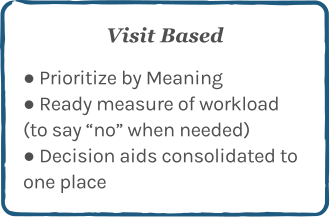
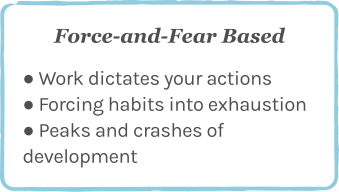
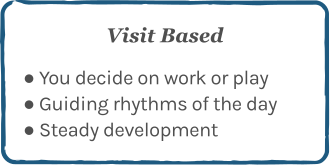
You don't have to wait for a deadline to do something. Getting into something is not about forcing yourself. Faking deadlines never seems to work anyway.
There are ways to bring yourself to work or play in a way that is genuine. By learning the natural waves of your mind's ability to engage, you'll be able to be honest with yourself and still make things that need to happen, happen.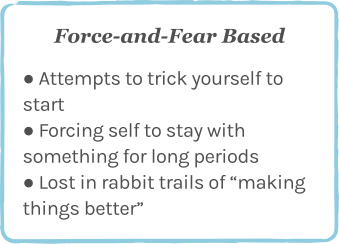
-

Staying on Course – with Hard Work
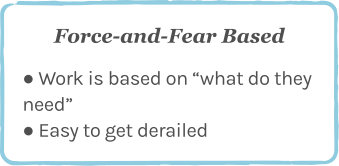
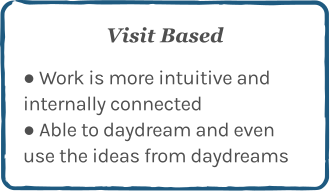
Hard work doesn’t have to be a misery. In fact, by knowing how to pay attention to your reactions, you might even find that moment where the work changes from “hard” to an engaging puzzle. When you align yourself with that window of challenge, the ship aligns, and you can start sailing strong.
-

Navigation - The Honor Guide & Your Waves of Focus
Too often, a trail of unfinished projects and ideas can follow in your wake. It can be a struggle to keep track of what you have been doing and what you'd like to get to. Learn to create a structure that lets you keep an honest conversation going between Past, Present, and Future You. Doing so will help you to choose and guide your day and even start traveling further distances, taking on larger and larger projects.
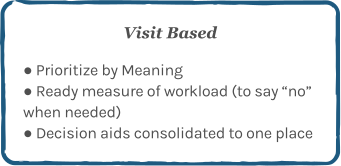
With an Honor Guide, we can more purposefully orchestrate the visits of our days.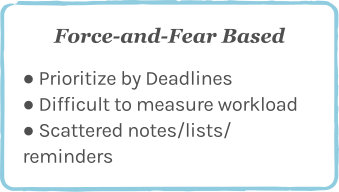
-

Crafting Messages – Tasks & Lists
Tasks and lists can become dreaded drains of productivity. But when we learn how to craft the wording of our work and play to support ourselves well, we not only develop confidence that we can get back to something, we can even feel strengthened when we do.
-

Clearing Decks – Buckets & Overflow
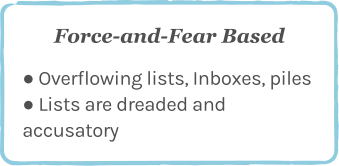
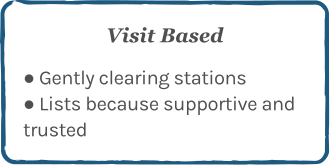
Overflowing piles, unread emails, and more are regular sights for a Wandering Mind. With the skills learned throughout the course, we can now begin clearing them and get powerful tools like an Inbox back into the fold. More importantly, we can set things aside and have them wait for us for when we are ready, rather than constantly react.
-

Settle & Restore
Coming to a calm and settled place, the waves of the moment no longer smash into us and instead we decide on the waves we wish ride. Practicing the core concepts of the Waves of Focus methodology can be as simple or as complex as we desire in the moment.









Waves of Focus met several needs for which I had long struggled to find resources.
It helped me recognize the subtle emotional dynamics that not infrequently thwarted even my best-laid productivity plans. It helped me approach these challenges from a place of gentle awareness and accountability rather than paralysis, panic, or shame.
It taught me concrete techniques to prevent certain familiar problems, and also to respond in the moment when I get stuck despite my best efforts.
And it gave me a great sense of encouragement by doing all these things in the company of others with similarstrengths and struggles, under the expert guidance of Kourosh.
I had never understood why other people could do everything on time in an orderly way, while I was a victim of deadlines and overflowing inbox lists. Definitely, I have a wandering mind. After years of trying multiple time management methods and applications, I have finally started to improve my productivity thanks to this course. It
teaches the basic concepts that can be applied to several systems (from pen and paper to fancy apps). You learn how to decide what to do in the present moment (the anchor technique), principles of organizing, ways to engage in a task and make transitions to other tasks, an easy way to daily manage lists, and how to control your inbox overflow. Once you understand the concepts, rather than following fixed rules, you start applying your own time management method.
The course has not only given me a few tools, but has actually given me the means to, I guess leverage those tools into a system that will allow me to process what really is almost 50 years worth of accumulated desires that are represented by reams of post-its, papers, notebooks, etc. which I've been carrying around in what I've just learned that people with ADHD refer to as a "doom box".
You might think of it as the bag under your bed. My doom box is, in fact, all the undone things that, for what I think of as psychological reasons, I've not been able to attend to. And the course has given me, first the mechanism, the muscles to develop a system to attend to them. I should say, first a way to guide myself to attend to them and then second a system for actually attending to them.
And that's been, as I say to everyone who asks, a life changer. I wake up happy, and I have not done that for most of my life.
Kourosh I think you are on to something wonderful. This course does not tell one how to live their life but gives one the tools to figure out how to live with dignity. I needed to figure out how to get myself out of my chaotic existence. You presented the
materials with respect to all, no judgements . The class participants were a highly educated group. Which I think indicates how universal this problem of scattered mindlessness is in our modern world. Some of the material was a ah ha moment...I remember that, which reinforced the reasoning behind the course modules. Universal knowledge that just gets lost in the information flow we are overwhelmed with as individuals.
The premise of the class is grounded on presence. How simple but difficult for one to maintain. The course gives one a method on how to get back sane living after losing their way. Having an exact technique to gather up ones ideas, goals and actions is invaluable. The emphasis on being honest with ones self is a important part of this method. After all we all play those mental games with ourselves.
Thanks so much for all of your work. I used GTD for many years. It was helpful. I then used Mark Forster’s work. It was even more helpful.
Then I discovered your work. It is simply transformational; the depth of your work allows me to change how I meet the moment in front of me, as well as create a structure to guide those moments.
The course is well suited for a wandering mind. It is very well structured and easy to follow without overwhelm or boredom. Modules are divided into short lectures, each just a couple of minutes long, with frequent reflection points and exercises to implement concepts. A few simple methods presented at the beginning were easy to weave into my routine and quickly started bringing tangible results: less procrastination, improved prioritization, less decision fatigue, less clutter. I got to nudge forward projects that were idle for months. Initiating work became easier and doing tasks I don't enjoy less painful.
An important part of the course is the community space with a forum and live calls. It is a place one can show up authentically without fear of judgement, get practical advice, or just belong with the sense of "I am not the only one struggling with this".


-


 How do I know if this course is for me?
 I'm continuously working on refining and improving the course based on feedback and new insights, so I cannot guarantee an exact timeline for the release of future modules.The pricing reflects this uncertainty. I plan to increase the cost as future modules become available.While I am taking my time in building the remaining planned modules to ensure quality, I also have a clear interest in completing them at an efficient pace so you and the rest of the community can enjoy and benefit from them.I've put these pieces together over decades from multiple sources, including psychology, psychoanalysis, mindful/meditation, productivity, and mastery.After hours, days, week, and years of putting together various systems, I've been able to distill the essence to better work with wandering minds.
-
How do I know if this course is not for me?
Of course, this course is not for everyone. Consider not taking this course if:You are looking to do more than is actually possibleYou don't have time to make an effort to improve your attentionYou already have a solid system of workYou are looking for a replacement for therapy or medicationYou are looking for shortcuts and quick fixesYou are being forced by someone else to take the class
-
Will this help me if I have ADHD?
ADHD is many things. In my 20+ years of psychiatric work, I have never seen two people with the same set of symptoms. Having said that, these principles were very much developed with clients and readers who have struggled with ADHD, anxiety, and more that contribute to what I've termed a “wandering mind”.More accurately, have you ever found yourself doing something you didn't mean to be doing? Have you ever caught yourself doom scrolling for longer than you intended?Whatever that distinction is—that part of you that says “do this thing!”, and that part of you that says “nope!” and vice versa, that's the relationship I'm trying to help you with.Please do note that I will not be functioning as a psychiatrist, physician, or therapist in this course
-
Can't I learn this on my own?
Quite likely, you can find these principles on your own. But doing so, piecing together different systems, and designing something that works for you, can take a tremendous amount of time and effort.I've put these pieces together over decades from multiple sources, including psychology, psychoanalysis, mindful/meditation, productivity, and mastery.After hours, days, weeks, and years of putting together various systems, I've been able to distill the essence to better work with wandering minds.
-
Why not use another system?
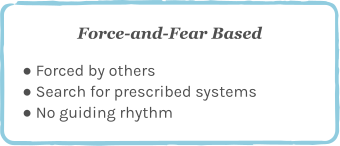
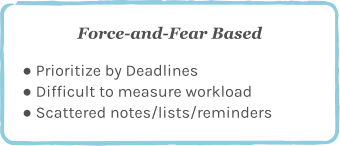
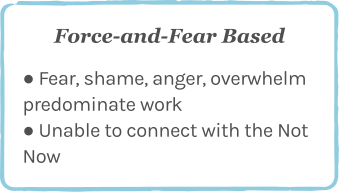
Several powerful systems like Getting Things Done, the Pomodoro Technique, Zen to Done, Don't Break the Chain, Deep Focus, and more, all promise a depth of focus. And they often deliver. But they often depend on an approach that doesn't take the wandering mind or Fear-and-Force methods of work into account.All of them require several important mental muscles to build. Once you have those muscles, those systems and more can blossom.Further, quite often those with wandering minds have unique systems already in place. Some parts work, while others regularly collapse, held together with duct tape and paperclips, often needing restoration at the worst possible moments.Waves of Focus can help you take what already works for you and shape it to support you even more and be more robust and sturdy.
-
How long will the course take?
Your life has its own ups and downs. You have your own sense of the time you can devote. I encourage a daily visit, whether for a few moments or however long you’d like to devote that day. At that daily clip, I think you can get through the first modules in a few weeks. I encourage taking your time - maybe 2-3 months to move through in a way that would let you implement the ideas and start seeing changes unfold.
-
What do I get as a member?
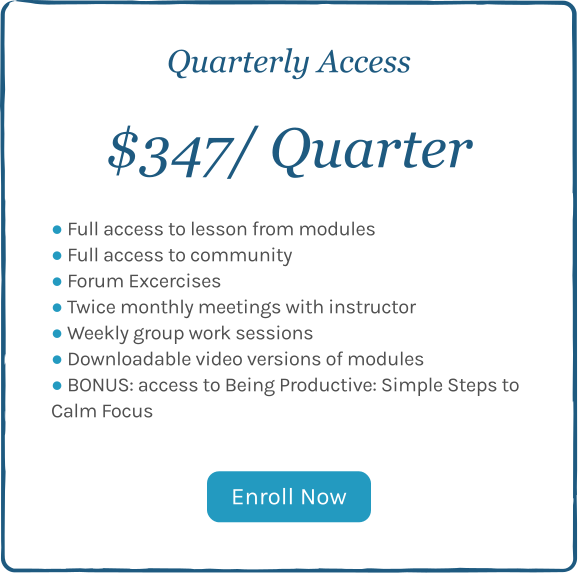
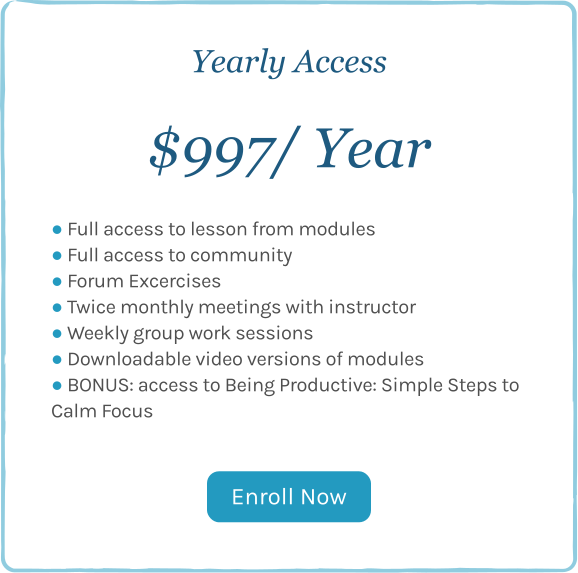
Access to all course modules as they are built from scratch.Access to forums and exercises to support one anotherTwice monthly Problems and Progress meetings - (recorded)Weekly work sessions - (not recorded)
-
Can we discuss OmniFocus, DEVONthink, or otherwise in the community?
Absolutely. Whatever the tools you are using, we can discuss the nuts and bolts of how to use them, and where they fit within or without the Waves of Focus course.
-
How different is this from your other products?
Waves of Focus is probably closest in nature to a blend of Being Productive – Simple Steps to Calm Focus and Workflow Mastery. Being Productive is a self-paced course that takes the user through the individual, foundational steps and habits that shape a solid working system. It is adaptable to just about any other system out there. Many people wrote in to say that they found it transformational and that they refer back to it regularly. Workflow Mastery is about building from the basics of a workflow up through the most advanced with a deep focus on the psychological aspects involved. However, there is a subset of people for whom the principles don’t quite take. Their Inbox still overflows, procrastination continues unabated, and it is difficult to even make it through the course itself. Whether creative, with ADHD, anxiety, or otherwise, there is a continued tendency to skip past whatever the intended focus is. Overwhelm and frustration pervade. In working with clients, one on one, we would try to find where the tires just weren’t connecting with the road. Waves of Focus is the result of those discussions. The years of frustration can build in such a way as to stand in one’s own way and atrophy certain muscles. While there are several tips and tricks to share, there is a process of exercise that seems to be helpful. More than just a change of perspective, a person needs to be able to practice a care for the Future Self. Waves of Focus is about doing just that in the context of meaningful work.
-
Will you turn this into a book?
I haven't decided yet.Still, having written several books, I've grown quite fond of them. Many readers have been quite happy with them.I expect changes and adjustments to Waves of Focus as I continue to develop the course and videos. As I bring them into a more solidified shape that lends itself well to a book, I'll certainly consider it.
-
What if I'm too busy right now?
There's a wonderful saying that you should meditate for twenty minutes per day unless you are busy, in which case you should meditate for an hour per day.I recognize the snideness in the comment, too, but the sentiment is important.
-
What time are the meetings?
Please note that dates and times are subject to change and often do. But typically:The co-working sessions are on Fridays at 10a CT / 4p GMTMonthly meetings #1 (Q&A, hot seats, ...) are on second Fridays at 12:30p CT / 6:30p GMT (the next one is March 14th)Monthly meetings #2 (Q&A, hot seats, ...) are on fourth Wednesdays at 5p CT / 11p GMT (the next one is this Wednesday)
-
Will I be able to keep the videos if I discontinue the membership?
No, they are only available as part of the membership. Currently, a purchase option is not available.
-
What is the refund policy?
You may cancel and get your money refunded within 14 days, but only if you give it a genuine try. You must post in the forums, explain what you've tried, what does and doesn't work, try any solutions offered, and if you're still not satisfied, send a direct message. You'll then have your money refunded and the course discontinued.
-
When is the next session? How much will it cost?
Launches are not regularly scheduled and tend to occur once/year, though that may change. Similarly, prices are only announced when doors open. If you’d like to know about the details of the next opening as soon as possible, be sure to sign up to the newsletter.